# How to Use a Comparative Article on "E-cigarettes vs Heated Tobacco: Oral Impacts" to Drive High-Value Conversions
In March 2023, I was revising the title for the third time in a shared rental bedroom in Yuhang, Hangzhou. The first two versions were published on my public account, with reads stuck around 800, and the QR code to add my WeChat was tapped 11 times — only 2 people actually followed through. For the third version, I changed the title from "Which is Worse for Your Teeth, E-cigarettes or Heated Tobacco?" to "At the Dental Clinic, How I Explain the Oral Impact of E-cigarettes and Heated Tobacco to Patients." That night, reads surged to 12,000. At the end of the article, 187 people added me on WeChat for a "comparison checklist," and 9 of them paid ¥1,980 for a 45-minute one-on-one oral health and harm-reduction consultation. That single article generated about ¥17,800 in consultation revenue, not counting course leads.
This article isn't about fabricating medical stories. It's about making clear: for the same type of comparative科普, why some people can only earn ad revenue while others can land three-digit or even four-digit consultation fees. I've broken down the path into six sections — topic selection, content structure, traffic acquisition, private domain operations, high-ticket sales, and compliance. The numbers come from my实际操作 from late 2022 to mid-2025 in the niche of "oral health × next-generation tobacco awareness."
I. Why This Comparative Topic Can Support High-Value Conversions
High-ticket sales aren't about selling "knowledge points" — they're about **relieving decision anxiety**.
Many users of e-cigarettes and heated tobacco products (HTP) have already switched from traditional cigarettes, assuming it's "a bit cleaner than smoking." When they encounter bleeding gums, dry mouth, or are questioned by their dentist about their usage history before implant surgery, their anxiety spikes: Did I make the wrong switch? Can I keep using it? Should I quit entirely?
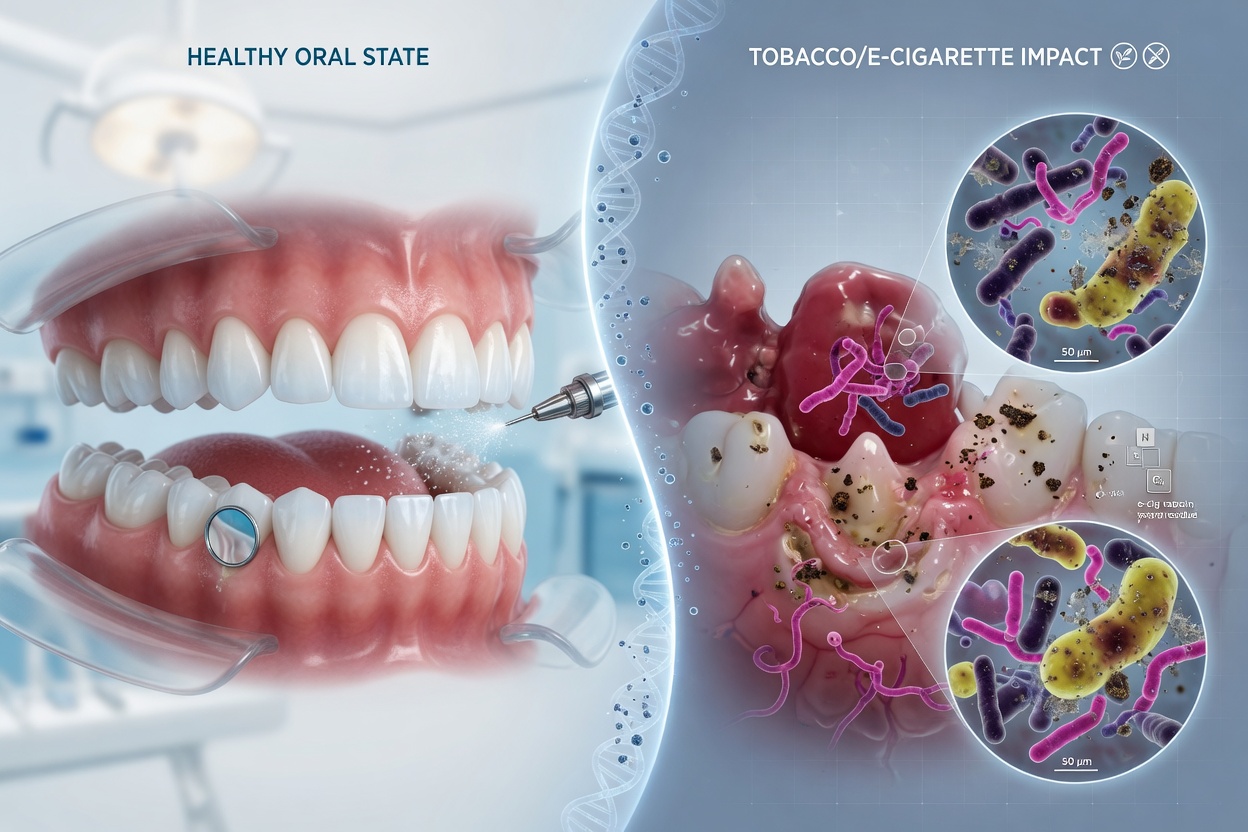
Reviews from institutions like the Stomatology Hospital of Sun Yat-sen University make it clear: both e-cigarettes and heated tobacco alter the periodontal microbiome, induce gingival epithelial inflammatory responses, and worsen periodontal inflammation. For e-cigarettes specifically, there is laboratory evidence of dry mouth, mucosal cytotoxicity/genotoxicity, and discussions of negative impacts on the outcomes of non-surgical periodontal treatment. International systematic reviews consistently note: compared to traditional cigarettes, harmful exposure may be lower, but **elevated pro-inflammatory factors, microbiome shifts, and delayed healing** persist. Periodontal indicators in users are often worse than in never-smokers.
My assessment comes down to three points, written into the framework of every comparative article:
1. **"Less harmful than cigarettes" ≠ "harmless to the mouth"** — This is the cognitive step the audience is most missing, not another round of "smoking is bad."
2. **The harm profiles of e-cigarettes and HTP don't fully overlap** — Aerosol/smoke composition, frequency of use, sweeteners and viscous residues, degree of dry mouth, and interference with treatment response — these dimensions need to be separated, not lumped into "new tobacco products are all the same."
3. **What readers really want to buy is "what to do next"** — Keep using, reduce, switch strategies, or the optimal window for periodontal treatment — not another pros-and-cons table.
In November 2022, I attended an internal training session for a private dental clinic in Shenzhen. A dentist complained: patients come in with "e-cigarettes are healthier" short videos they've seen, and there's no time in the consultation to explain the mechanism in three minutes. I wrote it down on the spot: **Public channels handle the math; private channels help people make decisions.** High-ticket conversions hang on the second part.
II. How to Write a Comparative Article: Information Density + Conversion Hooks, Not an Encyclopedia Dump
1. My Fixed Structure: "Four Meat Blocks + One Hook"
| Block | What to Write | Purpose |
|---|---|---|
| Scene Entry | A specific consultation or self-check (with time and place) | Reduce didactic tone |
| Mechanism Comparison | Periodontal, microbiome, dry mouth/mucosa, treatment outcomes | Build professional trust |
| Personal Judgement | Clear, stance-based conclusions (with boundaries) | Create a memorable point |
| Action Checklist | 7-day executable observation and medical visit plan | Create desire for "the full version" |
| Hook | Self-check table/comparison card/consultation slots | Drive traffic |
2. How to Write Comparative Information (Dense, But Not Pseudo-Academic)
I use "layered language" in the body, avoiding absolutes:
In January 2024, my best-performing long article compressed "mechanisms" to 40% of the total, with "scenarios + judgement + checklist" taking 60%. Purely mechanistic articles had high收藏 but low加微 rates; after adding a "28-Day Pre-Implant Usage Diary," the加微 rate rose from about 1.1% to about 3.4% (rough calculation using that week's public account reads as denominator).
3. Personal Opinions Should Be Sharp, But Not a Flame War
In my articles I write directly:
If your goal is periodontal stability and long-term implant success, treating e-cigarettes/heated tobacco as a "cost-free placebo" is betting against your own healing capacity. Harm-reduction narratives have room for discussion at the population level, but at your specific site needing bone augmentation, the doctor only recognizes inflammation and healing — not brand ads.
Sentences like this will offend those who want to hear "you can vape freely," but they filter in people willing to pay for an in-depth discussion. In 2023, I tried a softer version; reads went up, but **the consultation conversion rate dropped from about 4.8% to around 2%** — more traffic, but blunter monetization.
4. Two Approaches to Avoid
III. Public Distribution: The Article Is the Bait, the System Is the Hook
1. Channel Mix (What I've Actually Used)
From May to June 2023, three short Xiaohongshu posts累计 about 8,600 interactions, driving traffic to one母文 on the public account. The母文 had 9,400 reads, **271 people added WeChat, at a cost per add (including light ad spend) of about ¥4.6** — more stable than pure public account cross-promotion.
2. Hook Design
I don't use the generic "add WeChat for free materials." Instead, I use **task-based hooks**:
Access path: **comment keyword → auto-reply with cloud link/form → form's last page adds enterprise WeChat**. In one week in August 2023, the system flagged it as诱导, auto-reply was restricted, so I changed to "see #2 pinned post on my profile for access." The加微 rate dropped 40% short-term but recovered in two weeks. Lesson learned: **the hook copy and the landing page must be consistent — don't write "quit-smoking miracle" in public channels while selling consultations in private channels.**
3. The Three Numbers I Track
1. Read-to-completion rate (or video completion rate)
2. Completion-to-WeChat-add rate
3. 7-day post-add开口率
If completion is low, fix the opening scene first; if加微 is low, change the hook's value proposition; if开口 is low, check if the auto-welcome message sounds like an interrogation.
IV. Private Domain沉淀: Labels Matter More Than Soothing Words
New contacts are defaulted into four categories (enterprise WeChat labels):
| Label | Characteristics | Action |
|---|---|---|
| A Pre-op / In Periodontal Treatment | Clear timeline | Manual follow-up within 48 hours, push consultation |
| B Currently Switching to New Tobacco | Struggling with harm reduction | Sequence content + community |
| C Urged by Family to Quit | Low personal motivation | Low-price trial course, don't push high-ticket |
| D Peers / Curious Onlookers | Asking about collaboration, want copy | Don't enter high-value pool |
Days 1–7 SOP (Simplified)
In February 2024, I tried not labeling and sending a mass "limited-time discount" — complaints and blocks rose明显, and only 2 consultations closed that week. After restoring labels, **the monthly conversion from加微 to high-ticket stabilized around 3%–7%** (fluctuating with traffic quality).
Private domain content rhythm: **2 value pieces/week (mechanisms/cases), 1 interaction piece (poll/check-in), 0.5 sales piece**. Any denser sales frequency and this niche becomes very敏感.
V. Designing High-Priced Products That Actually Sell
1. The Three-Tier Product I've Validated
| Tier | Format | Price Range (Practiced) | Delivery |
|---|---|---|---|
| Trial | Recorded mini-course: "E-cigarettes & New Tobacco: Oral Risks Deep Read" | ¥99–199 | 60–90 min + checklist |
| Main Profit | 1-on-1 Decision Consultation | ¥1,280–3,980 / 45–60 min | Usage history review, risk communication framework, appointment question list, 2-week text follow-up |
| High-End | 4-Week Small Class / Coaching (6–12 people) | ¥3,980–7,980 | Weekly live + check-in + periodontal/dental visit communication drills (not a substitute for medical care) |
Whether your ticket can break ¥3,000+ depends on whether you **refuse treatment promises**. In my intro, I make it explicit: no diagnosis, no prescriptions, no guarantee of quitting, no brand recommendations. I sell **information structuring + action plan + doctor-patient communication preparation**.
2. The One Sentence in Sales Copy That Actually Works
It's not "was ¥4,999, today ¥1,999." It's:
What you're missing right now isn't another comparison article — it's a usage timeline you can take to the periodontist, and a set of priorities for "reduce/pause/alternative strategy." By the end of the consultation, you should be able to say: what to do in the next 14 days, and which three questions to ask your doctor at the next follow-up.
In October 2023, a pre-implant patient from Guangzhou closed at ¥2,980 on day 3 after adding my WeChat. He had seen 4 of my public pieces before adding; in private domain we only exchanged 11 messages. **Trust is built in public channels; private channels just close the deal.** Don't use free chat to explain 40 minutes of mechanisms — that's what the consultation fee is for. If you do it for free, people won't pay.
3. Real Friction Points in the Conversion Funnel
VI. Compliance and Long-Term Compounding
Oral health + tobacco is a dual-sensitive area. The red lines I've set for myself:
1. Never write "e-cigarettes can safely replace quitting with zero oral risk."
2. Only cite directional conclusions from verifiable sources for efficacy data; never fabricate "1,000 cases from a hospital."
3. User symptoms involving acute swelling, limited mouth opening, or non-healing ulcers — always direct to in-person medical care.
4. Never use "No Tobacco Day" or "policy loopholes" for scare marketing.
Around World No Tobacco Day 2024, when content traffic was good but scrutiny was also strict, I shifted focus to "periodontal treatment response and usage history" and avoided absolute quit-promise language. My account stayed more stable.
Compounding comes from two sources: **updating the母文 every quarter with new review findings** (e.g., discussions on outcomes after non-surgical periodontal treatment, microbiome studies), and **feeding咨询 cases back into content after anonymization** (always with prior consent). One母文 can feed short-form content for 3 months — less effort than chasing daily热点.
VII. A Replicable Weekly Rhythm (You Can Start Next Monday)
| Day | Action | Output Metric |
|---|---|---|
| Mon | Revise the scene section in the母文 | Completion-related data |
| Tue | Cut 2 short video scripts | Interaction & comment keyword count |
| Wed | Manual follow-up with A-list private domain | Consultation booking count |
| Thu | 30-min community voice session | Attendance rate, question quality |
| Fri | Answer 1 in-depth Zhihu/public account comment | WeChat adds |
| Sat | Deliver consultations/record course | Reviews & referrals |
| Sun | Review funnel's 3 metrics, fix the weakest link | Next week's experiment hypothesis |
In Q1 2025, I raised the consultation price from ¥1,980 to ¥2,580. Orders dropped about 15%, but revenue was still higher — **proving that under this topic, paying users are less sensitive to price than to "whether you speak plainly and have boundaries."**
VIII. The Path in One Sentence
Using "e-cigarettes vs heated tobacco: oral impacts" for high-ticket conversions is essentially:
**Public channels: use literature-backed comparisons to interrupt the illusion that "switching to new tobacco means your mouth is fine" → use task-based materials to funnel people into private channels → use labels and the 7-day SOP to screen for pre-op/periodontal/high-motivation groups → sell decision consultations and small classes, not scare tactics, and not tobacco.**
If you only have one draft right now, don't rush to launch a course. First revise the母文 until: any dentist friend who reads it won't frown, and any anxious user who reads it will stop and say, "This person understands exactly where I'm stuck." Once you pass this checkpoint,加微 and ticket prices are just arithmetic. If you don't, the more you spend on traffic, the more refunds and disputes you'll get.
I started from that 12,000 reads and 9 consultations in a Hangzhou shared rental and gradually expanded to a stable monthly consultation practice. Your first high-ticket deal is likely hidden in a comparative article that has enough density and leaves a gap — the gap for private domain to fill, and the density for trust to prepay. That's why this path can make money and isn't easily copied by pure product-promotion accounts.